





AmericanFarmer.us
  • Home
  • American Farmer News
  • American Farmer Topics
  • American Farmer Trends
  • American Farmer History
  • American Farmer Cooking
  • Ravens Design Shop

Cooking t-shirt from RavensDesignShop.com

landscaper mug from RavensDesignShop.com

vegetablegardenboxes ad1

Spiritravels GreenHouses Ad

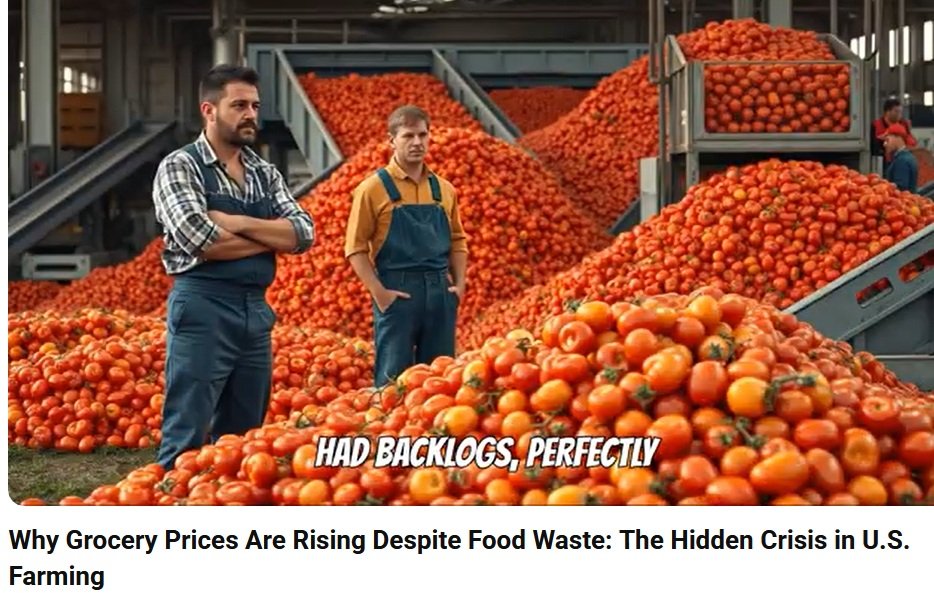
Why Grocery Prices Are Rising Despite Food Waste: The Hidden Crisis in U.S. Farming


 tomatoes

Click Here To View Video.


Grocery prices have become one of the biggest concerns for American families. Shoppers walk into supermarkets and see higher prices on meat, eggs, milk, vegetables, bread, and basic pantry goods. At the same time, millions of pounds of food are wasted every year. This creates a frustrating question: if so much food is being thrown away, why are grocery prices still rising?

The answer is more complicated than simple supply and demand. The video “Why Grocery Prices Are Rising Despite Food Waste: The Hidden Crisis in U.S. Farming” highlights a major problem in the American food system: food can be abundant in one place and unaffordable in another. The issue is not only how much food exists, but how that food is grown, harvested, processed, transported, stored, priced, and sold.

The Food Waste Paradox

One of the most shocking parts of the food system is that waste and high prices can exist at the same time. Farms may produce large amounts of fruits, vegetables, dairy, and meat, yet some of that food never reaches store shelves. Produce may be rejected because it is the wrong size, shape, color, or appearance. Other food may spoil before it can be transported or sold.

This means that food waste does not automatically lower grocery prices. In many cases, wasted food actually increases costs because farmers, distributors, and retailers must absorb losses. Those losses can eventually be passed on to consumers.

Key Point: Food waste does not mean food is cheap. When food is wasted, the cost of labor, land, water, fuel, packaging, and transportation has already been spent.

Why Grocery Prices Keep Rising

Grocery prices rise for many reasons. A tomato in the store is not priced only by what it costs to grow. Its price may include fuel, labor, packaging, refrigeration, trucking, insurance, retail overhead, and profit margins.

When any part of the food supply chain becomes more expensive, the final price at the grocery store can rise. Farmers may face higher costs for seeds, fertilizer, equipment, water, feed, land, energy, and workers. Trucking companies may pay more for fuel and maintenance. Grocery stores may pay more for rent, wages, utilities, and refrigeration.

The Hidden Pressure on American Farmers

Many consumers assume farmers benefit when grocery prices rise. However, that is not always true. In many cases, farmers receive only a small portion of the final retail price. A product may sell for several dollars in the store, while the farmer receives far less after distributors, processors, wholesalers, and retailers take their share.

Farmers also carry enormous risk. Bad weather, drought, flooding, pests, disease, equipment breakdowns, and changing market demand can destroy profits quickly. Even when farms produce large harvests, they may still lose money if prices are too low at the farm level or if they cannot get their crops to buyers in time.

Why Good Food Gets Thrown Away

Food may be wasted for many reasons that have nothing to do with quality or nutrition. Some common causes include:

  • Produce does not meet cosmetic standards.
  • Food spoils before it reaches stores.
  • There are not enough workers to harvest crops.
  • Transportation delays cause products to expire.
  • Stores overstock items to keep shelves looking full.
  • Restaurants and institutions order more than they use.
  • Consumers throw away food after buying too much.

This creates a painful contradiction. Farmers may watch edible crops go unused while families struggle to afford groceries.

The Supply Chain Problem

The modern food system depends on a long supply chain. Food often travels from farm to processor, then to distributor, warehouse, truck, grocery store, and finally to the consumer. Every step adds time, cost, and risk.

If one part of the chain breaks down, prices can rise quickly. A shortage of truck drivers, higher diesel prices, warehouse delays, cold storage problems, or packaging shortages can all make food more expensive.

Food Inflation and Consumer Frustration

Food inflation hurts households because groceries are not optional. Families may cut back on restaurants, entertainment, travel, or luxury purchases, but they still need food. When grocery prices rise faster than wages, consumers feel immediate pressure.

Many shoppers respond by buying store brands, using coupons, shopping at discount stores, buying in bulk, or changing meal plans. However, these strategies do not solve the deeper problem within the food system.

Why Farmers and Consumers Are Both Struggling

The crisis is not simply a battle between farmers and shoppers. In many cases, both sides are under pressure. Consumers are paying more, while farmers are often earning less than people assume. The middle of the supply chain can be where much of the cost is added.

This is why rising grocery prices can exist alongside farm losses and food waste. The system is inefficient, expensive, and vulnerable to disruption.

Possible Solutions to Reduce Waste and Lower Costs

Solving this problem requires changes at multiple levels. Some possible solutions include:

  • Creating better local food distribution systems.
  • Supporting farmers markets and direct-to-consumer sales.
  • Accepting imperfect fruits and vegetables.
  • Improving food donation systems.
  • Investing in cold storage and transportation.
  • Reducing unnecessary retail waste.
  • Helping farmers receive fair prices.
  • Educating consumers on food storage and meal planning.

Local food systems can help reduce transportation costs and waste, but they are not a complete replacement for national food supply chains. A stronger solution would combine local resilience with better national efficiency.

What Consumers Can Do

While consumers cannot fix the entire food system alone, they can make choices that help reduce waste and support better food economics.

  • Buy only what you can realistically use.
  • Store food properly to extend freshness.
  • Use leftovers creatively.
  • Buy imperfect produce when available.
  • Support local farmers when possible.
  • Plan meals before grocery shopping.
  • Freeze food before it spoils.

These small actions can help families save money while reducing unnecessary waste.

Final Thoughts

The rising cost of groceries is not caused by one simple problem. It is the result of a complicated food system affected by farming costs, transportation, labor, supply chain delays, retail pricing, and waste. The fact that so much food is wasted while prices continue to rise shows that the issue is not only food production — it is food distribution and efficiency.

The video brings attention to an important reality: America does not simply have a food shortage problem. It has a food system problem. Until farmers are supported, waste is reduced, and supply chains become more efficient, consumers may continue to face high grocery prices even while edible food is thrown away.

American Farmer News

  • American Farmer News
  • Dry Conditions and Increased Vegetation Set Stage for Higher Wildfire Risk in Texas
  • Farmweek News
  • June is Sorghum Month
  • King County's Local Food Finder
  • States With The Most Acres
  • Why Grocery Prices Are Rising Despite Food Waste: The Hidden Crisis in U.S. Farming

Dry Conditions and Increased Vegetation Set Stage for Higher Wildfire Risk in Texas

Wildfire officials are warning that much of Texas could see an uptick in wildfire activity this winter and into the early spring of 2026 as unusually high amounts of dried vegetation create prime conditions for fires to start and spread.

According to the Texas A&M Forest Service, grass and brush across large portions of the state have dried to a point where they have become highly flammable — a situation driven by last year’s above-normal vegetation growth followed by a lack of moisture. These dry fuels, combined with the typical wind patterns of winter and early spring, are expected to raise wildfire potential through March.

What’s Behind the Higher Fire Risk

During the dormant wildfire season, which runs through winter and spring, fires often ignite in “freeze-cured” grasses — dead vegetation that has dried after cold temperatures. Passing cold fronts during this season also bring periods of higher wind speeds, which can fan flames and make fires harder to contain.

Last year’s above-average grass growth means there is now an abundance of fuel available across many parts of the state. Areas located along and west of Interstate 35 — including the High Plains, Rolling Plains, and South Plains — now have dense grass loads that are susceptible to ignition under dry, windy conditions. Meanwhile, regions like the Hill Country and Cross Timbers also show exceptional grass buildup, adding to fire dangers there. South Texas and the Lower Gulf Coast currently pose a lower risk until grasses complete the freeze-curing process.

Wildfire Activity Already Above Normal

The Texas A&M Forest Service reports that wildfire response activity has been significantly higher than usual this season. From October through mid-January, fire crews responded to 434 separate wildfires that together burned over 11,000 acres — a level of activity about 136 % above normal for the period.

“Wildfire activity has increased across the state, driven by underlying drought conditions and above-normal grass production from last year’s growing season,” said Jared Karns, Fire Chief of the Texas A&M Forest Service.

Climate Patterns Favor Dry Conditions

Forecasters say that a La Niña climate pattern — characterized by cooler ocean temperatures in the central Pacific — is likely to persist into early 2026. Models from the National Weather Service’s Climate Prediction Center indicate that this pattern will bring warmer and drier-than-normal conditions to much of Texas from January through March. These conditions tend to suppress rainfall, reduce humidity, and increase wildfire risk during the dormant season.

Luke Kanclerz, head of the Texas A&M Forest Service Predictive Services Department, noted that atmospheric patterns linked to Southern Plains wildfire outbreaks have historically led to multiple large and high-impact fires that are difficult to control and that pose serious threats to both the public and firefighters.

Stay Aware — Most Wildfires Are Human-Caused

While large wildfire outbreaks tied to severe weather conditions account for a relatively small number of reported fires, they represent a disproportionate share of acres burned. Since 2005, such outbreaks have made up only about 3 % of wildfires but have accounted for nearly half of the total acreage burned in the state.

Officials emphasize that human activity remains the dominant cause of wildfires in Texas: roughly nine out of ten incidents start because of people. Residents and visitors are urged to stay alert and avoid outdoor actions that could spark a fire during periods of warm, dry, and windy weather.

If you see smoke or an active fire, contact local authorities immediately — early reporting and quick response can help protect lives, property, and natural resources. Texas A&M Forest Service also recommends checking the current wildfire situation and fire environment conditions.

American Farmer News

  • American Farmer News
  • Dry Conditions and Increased Vegetation Set Stage for Higher Wildfire Risk in Texas
  • Farmweek News
  • June is Sorghum Month
  • King County's Local Food Finder
  • States With The Most Acres
  • Why Grocery Prices Are Rising Despite Food Waste: The Hidden Crisis in U.S. Farming

  1. Farmweek News

Page 1 of 4

  • 1
  • 2
  • 3
  • 4
  • Privacy Policy
  • Terms of Service
  • Disclaimer
  • Sitemap
  • Help Desk Info
My Blog